Guest Blog: FOSDEM 2026 — Rust Devroom in Review
Hi Rust Foundation readers! As two of the long-time co-organizers of the Rust Devroom at FOSDEM, we wanted to share a brief look at this year’s event, along with a bit of history and a few personal takeaways in this guest blog.
About FOSDEM & the 2026 Rust Devroom
The FOSDEM 2026 Rust Devroom took place on February 1st 2026 at the ULB Solbosch campus in Brussels, Belgium.
FOSDEM is the yearly event at the center of the Open Source ecosystem in Europe, and it covers many topics in dedicated tracks, called “devrooms”.
This year, the Rust devroom featured 16 talks covering a wide range of topics, including embedded systems, game development, server-side development, data warehouses, profiling, Python integration, and Version Control Systems (VCS). This speaks to the versatility of Rust as it is being used in so many places up and down the software stack.
Talks, Proposals, and the Reality of Limited Time
With only 8 hours available for the devroom, every year we unfortunately have to filter and reject some proposals (around 60% on average) due to scheduling constraints. This year as well, we received more than 40 talk proposals on many different and interesting topics, and it was very hard to do the final selection.
Depending on the topic, we try to redirect some of them to other devrooms or to Birds-of-a-feather (BoF) sessions.
Among many others, in 2026 we were happy to see a dedicated BoF for Bevy and a talk about Graphite in the Graphics devroom. This shows that Rust has indeed become a core part of many communities and projects.
Crowds, Queues, and a Rust-y Gift
Anyone who has attended FOSDEM in the past is aware of how large a meetup it is, with rooms that can be completely full and people queuing for the upcoming talks. The Rust devroom was fortunate enough to get a room with a very large capacity (more than 500 seats), which meant no queues.
That’s great: everyone hates queues! But the truth is, the spontaneous gatherings for the “hallway track” are a core part of FOSDEM and the best place to make new friends. If you’re in the queue for coffee, for food, or for a devroom, then you know the person next to you has at least one thing in common: a shared interest in Free and Open Source Software.
As a gift to the hundreds of people who came through the doors to our devroom, we handed out wristbands with the Rust logo on them. Thanks to the Rust Foundation for designing and providing these lovely wristbands!
A Shift in the Rust Conversation
One interesting takeaway we noticed this year is that there are a substantial number of projects where people are tired of easily avoidable bugs. Tired of slow code. Tired of footguns. They are replacing their existing projects, piece by piece, with nuance and intelligence, with some ad-hoc components written in Rust. As the technology landscape evolves and the Rust ecosystem grows, it’s becoming clearer that open communication and cross-project collaboration are increasingly important in helping teams avoid these problems before they turn into long-term pain.
There is momentum building in the community. In previous years, we had talks about how it was possible to use Rust in certain contexts. Now we have a lot of talks about how Rust is replacing parts of other projects to help them with their stability and performance. We hope next year is the one where most talks are about how innovation happened because the Rust ecosystem was the only way it could have happened. This year, they were in the minority and mostly to do with embedded systems or systems programming: Fedor Smirnov talking about web-assembly on Nordic and ESP devices, Ali Polatel showing how to write an application kernel in Rust, and Glen De Cauwsemaecker talking about Rama – a very slick library for writing network services.
10 Years of Rust at FOSDEM
Looking back, the presence of a Rust community event at FOSDEM started exactly 10 years ago. The first iteration was a short informal session, organized directly on-site, where we both met in person for the first time.
At that time we had been attending FOSDEM for several years, initially just as part of the audience and later on as speakers or volunteers for different tasks (like handling cameras or heralding speakers for a devroom).
In 2015 Steve Klabnik gave a great talk about Rust, which was approaching its 1.0 release. Ewan was volunteering in that room, and became very interested in this new language. Luca was in the audience, working as a security researcher at that time and already following the rapid evolution of pre-1.0 Rust.
One year later, a proposal for a dedicated Rust devroom was submitted, but unfortunately not accepted. So in 2016, Ewan scheduled an informal BoF (Birds of a Feather) session, which is a 1-hour unconference where people show up and share ideas and experiences about a specific topic. Luca joined the session as well.
We were not expecting a large crowd, but we were both positively surprised when more than 25 people showed up for the BoF. It was a great experience and everybody was happy to meet other people interested in Rust at FOSDEM! A summary of that initial BoF was later posted to Reddit.
At the next Rust BoF, in 2017, more than 60 people showed up. As you can see in the photo, there was already not enough space in that small room for the growing interest in Rust. At the end of the event, Ewan asked if we should try to apply again for a devroom for the next year, and the response was unanimous: yes!

2017 – Second iteration of Rust BoF at FOSDEM
We managed to get the first dedicated devroom for Rust at FOSDEM in 2018, and it has been organized every year since then (barring 2021 due to COVID).
Since then, every year a small team — Ewan and Luca together with Andy Georges, Martin Junghanns, and Paul Horn — has been running the Rust devroom, setting everything up early in the morning and tearing it all down in the evening, already looking forward to the next year.
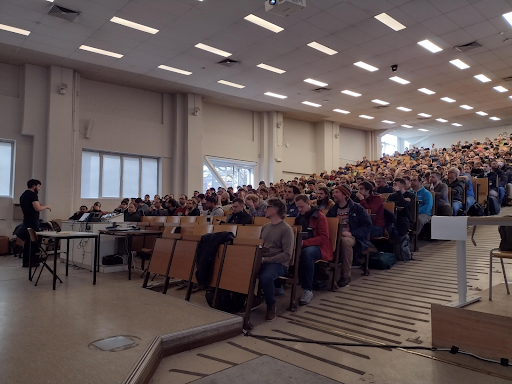
2026 – The most recent Rust devroom at FOSDEM
Looking back at how far Rust has come at FOSDEM over the past decade, it’s hard not to be excited about what the next few years will bring. We’re grateful to everyone who continues to show up, share their work, and help shape the community year after year.
